Egyptian Loofah – The Complete Guide to Origin, Grades & Quality
A step-by-step operational guide for wholesale buyers on container shipping, phytosanitary requirements, customs tariffs, and moisture control when buying loofah from Egypt.
Why do importers, spa suppliers, and private-label brands still ask for Egyptian loofah by name when cheaper sponges are easy to find? The answer is the fiber. Egyptian loofah is thicker, denser, and more resilient than most alternatives, and it holds its shape through repeated use.
That quality starts in the Nile Delta, where warm weather, fertile soil and careful farming give the gourd time to build strong fiber. It continues after harvest, through hand-picking, sun drying, cutting, and pressing.
This guide covers where Egyptian loofah comes from, how it is grown and processed, how fiber is selected, which product forms are available, and what to check before you approve a shipment.
What You Will Learn
- Why the Nile Delta produces stronger, denser loofah fiber
- How Egyptian loofah moves from seed to export in seven steps
- How fiber is selected and what Export Grade A means
- The difference between natural unbleached and standard finishes
- Which product forms you can source, from raw bales to finished gloves
- A simple checklist for judging quality and choosing a supplier
What Is Egyptian Loofah?
Egyptian loofah is the dried, fibrous skeleton of Luffa aegyptiaca, also known as Luffa cylindrica. It is a gourd in the cucumber family, not a sea sponge. Once the gourd matures and dries, the skin, pulp, and seeds are removed, leaving a natural network of fibers.
A 2020 scientific review of luffa fibers found that the material is mostly cellulose, with hemicellulose and lignin adding stiffness. Because it comes from a plant, natural Egyptian loofah is renewable and biodegradable, which makes it a strong fit for brands moving away from plastic bath sponges.
Why the Egyptian Origin Matters to Buyers
The botanical name aegyptiaca points to the plant’s long history along the Nile. For buyers, the origin signals a known fiber profile: firmer texture, larger size, and less crumbling in use. To see how this compares with other sources.
A clear origin also helps importers. Every Agro Village shipment includes a Certificate of Origin, which gives retailers and brands a traceable story to share on packaging and product pages.
Loofah Egypt: Where and How It Grows
Loofah production in Egypt is centered in the Nile Delta. Each stage of growing and handling affects the fiber that reaches your warehouse.
The Nile Delta Advantage
Luffa is a slow, heat-loving crop. The University of Illinois Extension and NC State Extension both stress that it needs a long, warm, frost-free season. Egypt’s climate provides that, so gourds can mature fully on the vine.
The Delta’s fertile soil and Nile-fed irrigation keep the vines growing through the hottest months. With steady water and strong sunshine, the gourds reach full size before harvest.
Chemical-Free Cultivation
Our loofah plants are grown using chemical-free agricultural practices that help develop strong, full fibers. For natural and eco-focused brands, this supports a clean product story from the farm onward.
Hand-Harvested at Maturity
Each gourd is hand-picked at the right moment of maturity to secure maximum fiber strength and density. Picking too early gives thinner, weaker fiber, so timing matters. See [link: Hand-Harvested Egyptian Loofah: Why Timing Matters for Fiber Strength].
Sun-Dried for Export
After harvest, the loofah is dried under direct sunlight in Egypt’s warm, dry climate until it is completely free of moisture. For buyers, this is one of the most important steps, because damp fiber can develop mold during long sea freight.
From Seed to Export: The 7-Step Process
At Agro Village, every Egyptian loofah goes through the same seven steps:
- Seed planting: the finest loofah seeds are selected and planted in fertile Egyptian soil.
- Growth on the farm: plants are tended with chemical-free practices to develop strong, full fibers.
- Harvesting: fruits are hand-picked at maturity for maximum strength and density.
- Sun drying: loofah is dried in direct sunlight until free of moisture.
- Cutting and sewing: fiber is cut and sewn into gloves, pads, and custom shapes.
- Pressing and packaging: loofah is pressed to reduce volume without damaging the fiber, then packed in sealed bales.
- Global exporting: shipments go to customers in more than 40 countries.
What Makes an Egyptian Loofah Sponge Stronger?
Three fiber traits set an Egyptian loofah sponge apart:
- Strength and durability: the fibers are thicker and more resilient, so they outlast other varieties.
- Density: a tight, robust fiber network gives effective exfoliation without crumbling.
- Size: Egyptian loofahs grow larger and fuller, which gives more usable material and allows long formats such as an 11 x 90 cm full-body loofah.
For buyers, these traits mean products that keep their shape, fewer weak pieces in a shipment, and more options when cutting raw material.
How Egyptian Loofah Is Selected and Graded
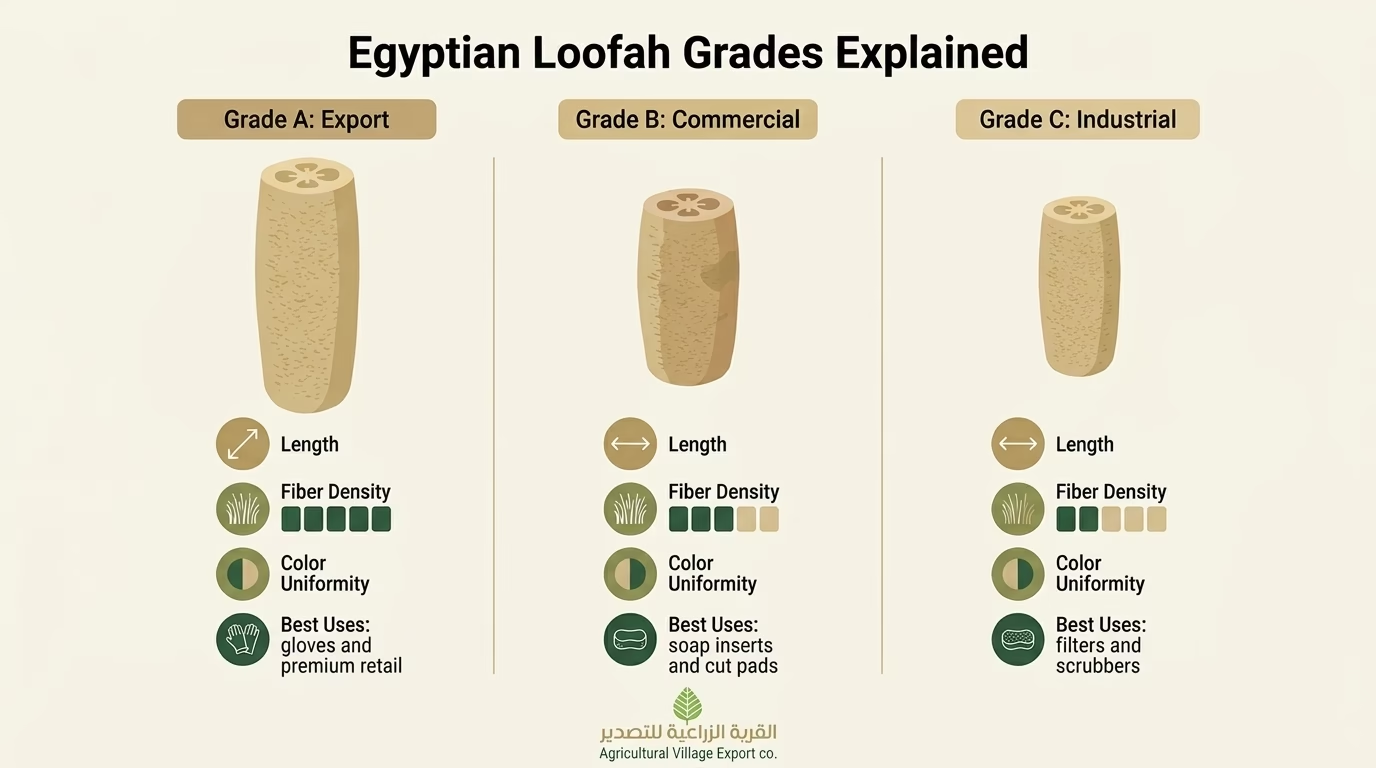
There is no single international grading standard for loofah. Instead, exporters and buyers agree on the fiber traits that matter for each product. At Agro Village, products are supplied as Export Grade A, and raw material is selected by three factors:
- Quality level: overall soundness and appearance of the fiber
- Fiber length: longer pieces suit full-body and back formats, shorter pieces suit pads and cut pieces
- Density: denser fiber gives a firmer scrub, softer fiber gives gentler exfoliation
Tell your supplier which products you make, and the bales can be selected to match. To understand each factor in more depth.
Egyptian Loofah Product Forms
Natural Egyptian loofah is available in several forms, depending on whether you process the fiber yourself or sell a finished product:
- Raw loofah bales: whole, unprocessed loofah for factories and workshops that cut to their own specifications
- Cut-to-size pieces: shower loofah cut and shaped to your required dimensions
- Gloves: standard glove (16 x 20 cm), padded glove (16 x 22 cm), finger glove and Moroccan-style glove
- Pads: heart-shaped loofah and oval pad (12 x 16 cm)
- Long formats: back scrubber (typically 11 x 31 cm) and Marina extra-long loofah (11 x 90 cm)
- Hospitality: mini hotel loofah and raw loofah balls with a hanging rope
Browse the full range on our Products page.
How to Judge the Quality of Egyptian Loofahs
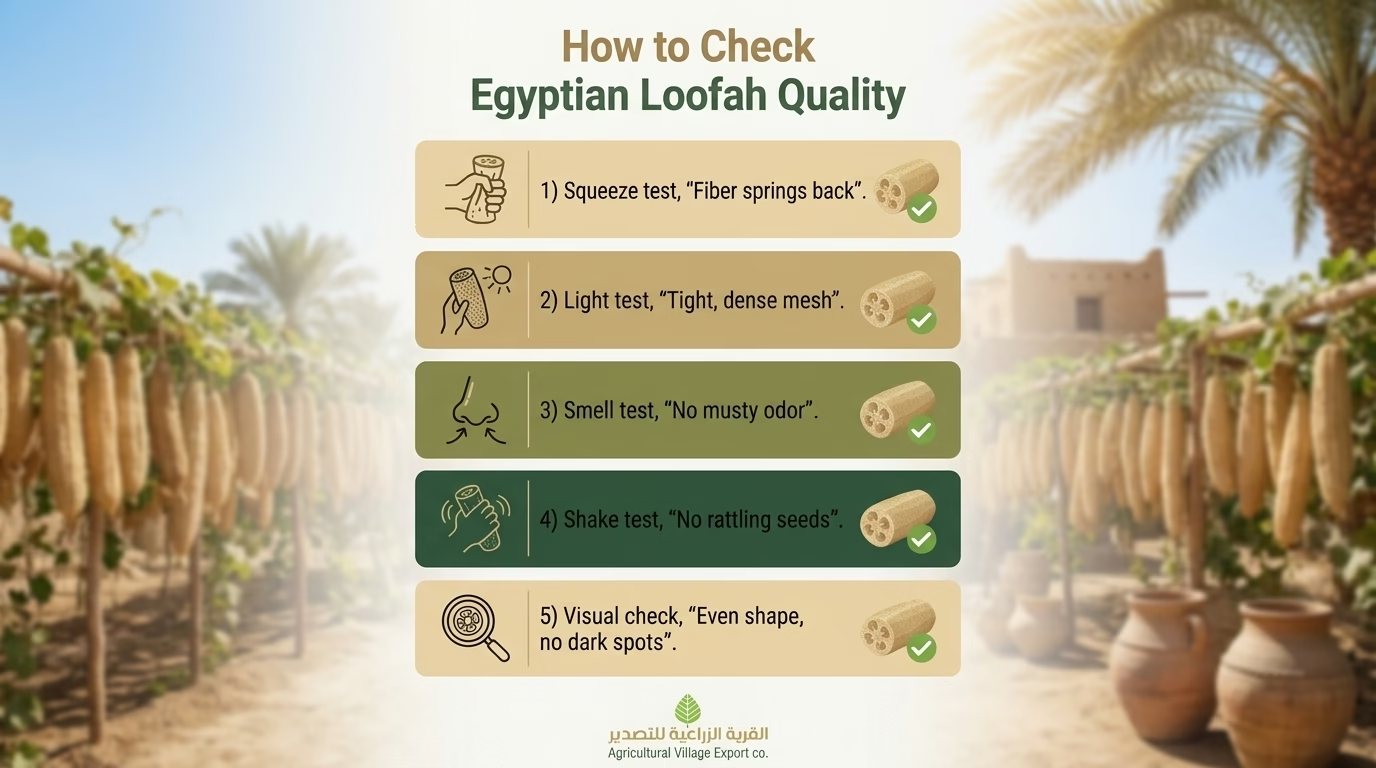
Whether you buy raw bales or finished products, a few quick checks on a sample can prevent costly surprises after delivery:
- Density: squeeze the sponge firmly. Good fiber springs back instead of collapsing. Held up to the light, a dense mesh lets little light through.
- Moisture: a well-dried loofah feels light and crisp, with no musty smell. Dark speckles usually mean the fiber stayed damp too long.
- Cleanliness: shake the sponge. A rattle means seeds were left inside. Check that no skin fragments or dust remain in the cavities.
- Shape and finish: look for even shapes, no crushed ends, and, for finished products, secure stitching.
Remember that natural color varies. Judge quality by density, strength, and cleanliness, not by a perfectly uniform color.
Sourcing a Loofah Sponge Supplier in Egypt
Choosing the right loofah sponge supplier in Egypt matters as much as the fiber itself. These are the points to check.
Control of the Full Chain
A reliable exporter manages the chain from farm to container. Agro Village works with farmers under cultivation contracts and oversees drying, cutting, sewing, and pressing, which keeps quality consistent from one shipment to the next.
Export Documents
Every shipment should come with a Commercial Invoice, a Certificate of Origin, and a Phytosanitary Certificate. These confirm the Egyptian origin and support smooth customs clearance.
Samples and Private Label
Always request a sample before ordering in volume. A good supplier can match fiber length, density, and packaging to your needs, or produce under your own brand. Agro Village offers free sample development, custom dimensions and branded packaging through its Private Label service.
Order Volumes and Shipping Terms
Egyptian loofah is supplied in bulk export orders by container, mainly under FOB or CIF terms. Sea freight generally takes 14 to 25 days, while samples travel by air.
Request a Free Sample of Egyptian Loofah
Test the fiber yourself before you commit. Agro Village sends free samples of raw bales and finished products, so your team can check density, finish and quality against your own standards.
With more than 20 years in the Egyptian loofah trade, we manage every step from hand harvesting and sun drying to sealed export bales. Whether you need raw material for your factory, a ready-to-sell bath range or a private-label line, our team replies within 24 hours.
Source Egyptian Loofah Direct from the Grower
Raw material bales and finished bath pieces, shipped FOB or CIF with full export documents. Bulk export orders by container, and a written quote within 24 hours and a written quote within 24 hours.
Get a Wholesale Quote Request a Free SampleConclusion
Egyptian loofah earns its reputation from where it grows. The Nile Delta’s climate and soil give the gourd time to build thick, dense fiber, and careful sun drying protects that fiber on its way to market.
Grades A, B, and C help buyers match fiber to purpose, from premium gloves to industrial filters. Natural and bleached finishes serve different brand stories, and simple checks for density, moisture, and cleanliness show whether a shipment meets your standard.
Take Away Message: Origin, grade, and handling all decide the quality of a natural sponge. When you source Egyptian loofah from a supplier that controls the full chain, you get stronger fiber, consistent batches, and a product your customers will notice.
FAQs
These are the questions buyers and shoppers ask most often about Egyptian loofah.
Why is Egyptian loofah considered among the best?
Egypt’s long, hot growing season and fertile Nile Delta soil let gourds mature fully on the vine. The result is thicker, denser fiber that keeps its shape and resists crumbling.
Is a loofah a plant or a sea sponge?
A loofah is a plant. It is the dried fibrous interior of the Luffa gourd, a relative of the cucumber, and has nothing to do with marine sponges.
What is the difference between natural and bleached loofah?
Natural loofah keeps its original cream-to-tan color and is not chemically whitened. Bleached loofah is lightened with a diluted bleach rinse for a whiter retail look.
How long does a natural loofah last?
Dermatologists at Cleveland Clinic recommend replacing a bath loofah every three to four weeks, or sooner if it smells musty or shows mold. Rinse it and hang it to dry outside the shower after each use.
How can I tell if a loofah is good quality?
Look for dense fiber that springs back when squeezed, a uniform color, no rattling seeds, and no musty smell. An even shape and clean inner cavities also point to careful processing.